
RBA Teacher Immersion Reflections
As part of ETAWA's commitment to fostering and developing economics teachers skills, three teachers were supported by the association to attend the Reserve Bank of Australia's Teacher Immersion Event in the July school holidays. As part of the event, teachers were given the opportunity to network with other educators from across the country, and hear the reflections and analysis from a number of senior figures in the Reserve Bank of Australia. The three teachers have provided their own reflections on the day that provide contemporary data, insightful analysis, and reflections for educators of economists on how they can bring the subject to life in their own classrooms.
From Economic Models to Policy Judgement
My reflection from the 2026 RBA Teacher Immersion Program
In July, I attended the Reserve Bank of Australia's Teacher Immersion Program in Sydney with the support of ETAWA.
 A key takeaway was not simply access to contemporary economic data, but insight into how economists move from evidence and models to
judgement when indicators conflict and policy objectives compete. This is particularly timely for the 2027 SCSA Economics ATAR syllabus,
where the revised grade descriptions place greater emphasis on integrating economic concepts, models and data to make well-supported
judgements.
A key takeaway was not simply access to contemporary economic data, but insight into how economists move from evidence and models to
judgement when indicators conflict and policy objectives compete. This is particularly timely for the 2027 SCSA Economics ATAR syllabus,
where the revised grade descriptions place greater emphasis on integrating economic concepts, models and data to make well-supported
judgements.
Sarah Hunter, Assistant Governor (Economic), demonstrated this process through the RBA’s assessment of current macroeconomic conditions. GDP growth, household consumption, labour-market conditions, wages, inflation and productive capacity were considered collectively rather than as discrete indicators. Importantly, the outlook remained conditional: demand is expected to moderate and labour-market tightness to ease, while uncertainty remains around external disruptions and the lagged effects of monetary policy.
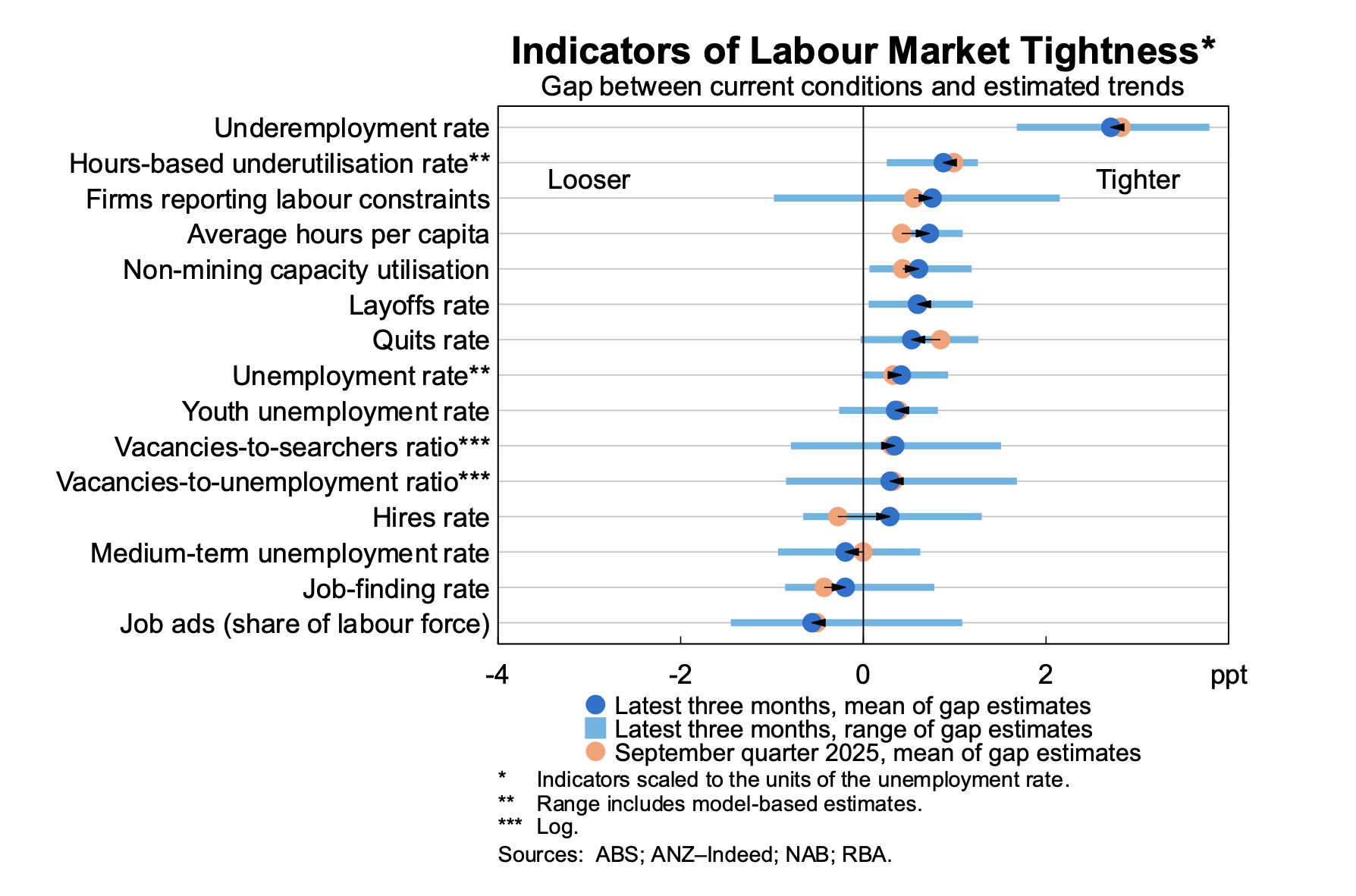
Figure 1 provides a useful example of the judgement required when economic indicators do not provide a uniform signal. Measures based on underemployment and hours-based underutilisation indicate comparatively tight conditions, while job advertisements and job-finding sit on the looser side of trend; the estimated ranges for several measures cross zero. Asking students “To what extent does the evidence indicate that the Australian labour market remains tight?” requires them to weigh the magnitude, direction and uncertainty of competing indicators rather than relying mechanically on the unemployment rate.
Michelle Bergmann’s analysis of inflation provides another opportunity to deepen this reasoning. Inflationary pressures were considered through domestic demand and supply conditions, external shocks and inflation expectations. External pressures may transmit through exchange rates and import prices, with the eventual effect on consumer prices influenced by the extent of cost pass-through. For students, this moves analysis beyond simply classifying inflation as “demand-pull” or “cost-push” towards considering its source, transmission and persistence.
Kate Hickie’s monetary policy session extended this thinking to the policy implications of a negative supply shock. The 2027 syllabus explicitly requires students to analyse changes in aggregate supply using AD/AS and recommend policies to mitigate demand and supply shocks.
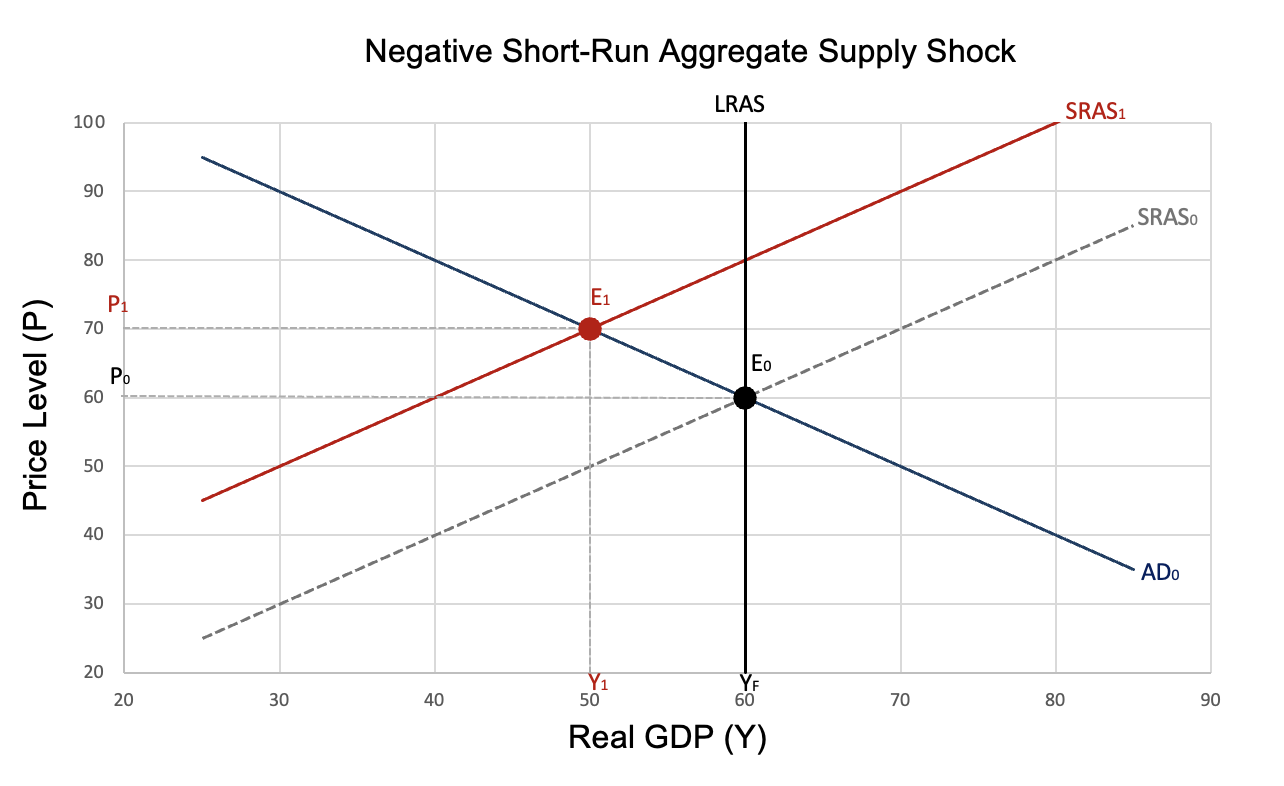 In Figure 2, a negative supply shock shifts short-run aggregate supply from SRAS₀ to SRAS₁, increasing the price level from P₀ to P₁ while
reducing real output from potential output YF to Y₁. The model is relatively straightforward; however, the appropriate policy
response is not. Hickie
demonstrated how a negative supply shock can place price stability and full employment in tension. Tightening monetary policy may contain
demand and reduce the risk of inflation becoming persistent, but it cannot directly reverse the supply constraint and may further weaken
output and employment.
In Figure 2, a negative supply shock shifts short-run aggregate supply from SRAS₀ to SRAS₁, increasing the price level from P₀ to P₁ while
reducing real output from potential output YF to Y₁. The model is relatively straightforward; however, the appropriate policy
response is not. Hickie
demonstrated how a negative supply shock can place price stability and full employment in tension. Tightening monetary policy may contain
demand and reduce the risk of inflation becoming persistent, but it cannot directly reverse the supply constraint and may further weaken
output and employment.
Conversely, a less restrictive response may limit further weakening in activity and employment, but risks allowing inflationary pressures to persist or become embedded in expectations. The appropriate response therefore depends on the nature and persistence of the shock, prevailing economic conditions, inflation expectations and the RBA's assessment of risks.
A useful application for Unit 4 is therefore to provide students with Figure 2 alongside contemporary inflation, GDP and labour-market evidence and ask them to recommend whether monetary policy should tighten, hold or ease. A well-supported judgement requires students to distinguish the initial source of inflation from its likely persistence, weigh competing macroeconomic objectives, and recognise that monetary policy operates with lags. This avoids the mechanical conclusion that inflation above target necessarily requires a higher cash rate.
The immersion reinforced that contemporary data should do more than provide examples for established theory. Models provide a framework; data provides evidence; economic judgement requires students to reconcile the two under uncertainty. The 2027 syllabus creates an opportunity to make this progression more explicit, moving students beyond learning Economics towards thinking economically.
I am grateful to ETAWA for sponsoring my participation in the program and to the RBA presenters for sharing their expertise with the Economics teaching community.
Sayana Barnes
Iona Presentation College
.png) Overall, the Teacher Immersion Event was a highly beneficial professional learning experience. It increased my subject knowledge, provided
first-hand insight into Australia’s economic outlook and policy settings and strengthened my confidence in teaching senior Economics. The
opportunity to hear directly from RBA economists and policymakers was particularly valuable, as it provided information and perspectives
that can be transferred directly into my classroom teaching.
Overall, the Teacher Immersion Event was a highly beneficial professional learning experience. It increased my subject knowledge, provided
first-hand insight into Australia’s economic outlook and policy settings and strengthened my confidence in teaching senior Economics. The
opportunity to hear directly from RBA economists and policymakers was particularly valuable, as it provided information and perspectives
that can be transferred directly into my classroom teaching.